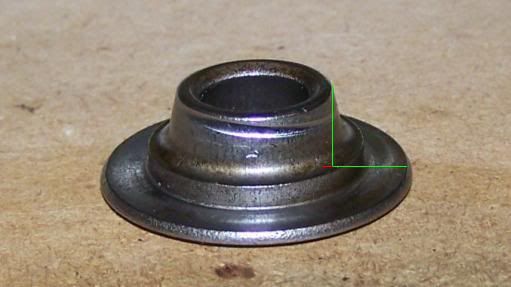
i fairly recently got a set of ported cylinder heads, they where fitted with double valve springs, on inspection, they have the wrong retaining caps, the small springs have been located on the cone of the cap as can be seen in this pic.
my question is what to do with them, if i machine where the green line is, there will only be 1mm (shown in red) holding the tapered part of the cap on to the spring surface, would this be enough? anyone know what proper double spring caps look like? both springs are same length, 1.75 inch (44mm)
It could be a bit dodgy machining them, if one breaks in operation you can kiss most of your motor goodbye. Also they look like they are made of sintered metal so they are not mega strong in the first place.
yea, i think the only good option is to get a set of collets made which have a narrower taper, and then this will allow more meat on the cap, i could also get titanium ones made up to reduce some weight.
If you can get away without them its a lot less frictional wear on the cam,
Retaining caps for double springs were a factory piece as fitted to the P5/6 engines, they may fit your springs,
THE SMOKING GNU
12.604 with an old boiler of a RV8 and no gas
WHY are there so many IANS on this site???????
ian.stewart wrote:If you can get away without them its a lot less frictional wear on the cam,
Retaining caps for double springs were a factory piece as fitted to the P5/6 engines, they may fit your springs,
The early ones were the non-sintered ones which are stronger. Having said that my heads were done by V8 Dev, they run double springs and sintered caps which is why I thought that there were some laters ones which were OK with double springs. (I hope they are OK as they are fitted to my heads!)
Ralphh85 wrote:anyone know how many rpm single valve springs are good for?
Ralph
I think the only people that could have you an absolute anwser to that would be the people that supply the springs. Bear in mind that the cam profile and the weight of the timing gear and valves all has a baring on the RPM limit of the valve train.
The other thing to bear in mind here is that all the other engine components have limits as well. The standard lifters are only good for 5800 RPM. The standard cast pistons are dodgy over 6200 (from memory)...etc, etc
valve springs are a big subject, with a huge amount of variables, cam ramp, valve size, valve lift,
They are a compromise at best, with the max closing rate to prevent float, and keep the valve under control when on back side of the cam, then there is resonance float where the damper coil comes into play.
some more interesting springs are coming available which partially alleviate the need for doubles under reasonable conditions, Beehive springs are gaining popularity, due to the shape they are self damping and lighter than normal springs, the other springs that come to mind are triangular section springs.
There was a interesting feature about Valve springs in Hot Rod last month, might be worth seeing if you can get a back copy or look on line at the hotrod web site
THE SMOKING GNU
12.604 with an old boiler of a RV8 and no gas
WHY are there so many IANS on this site???????
Also you need to bear in mind the age of the springs.
If you not going to be many miles, you could use singes, but change every year.
I've been Racing with a Temp engine as still sorting the parts for my 4.6
Standard 3.9 with a fast road cam (230 BHP ish)and a 4.0 front end, this is running 4500-6500 (plus it hit 7000 a few times) for the 20 mins sprint races I do, and I've done 15 (3 x 10) of these this year on this engine.
This is maybe pushing it to extremes but I don't care if the engine blows.
Current V8 car TVR 400SE 240 BHP
Current Project TVR Tasmin Race, with 3.9 running at 230 BHP
Currently building a 4.6 300 BHP Xbolted Engine for it. Solid Lifters and Group A rockers, Stange 4 heads, Pocketed piston, fully balanced.