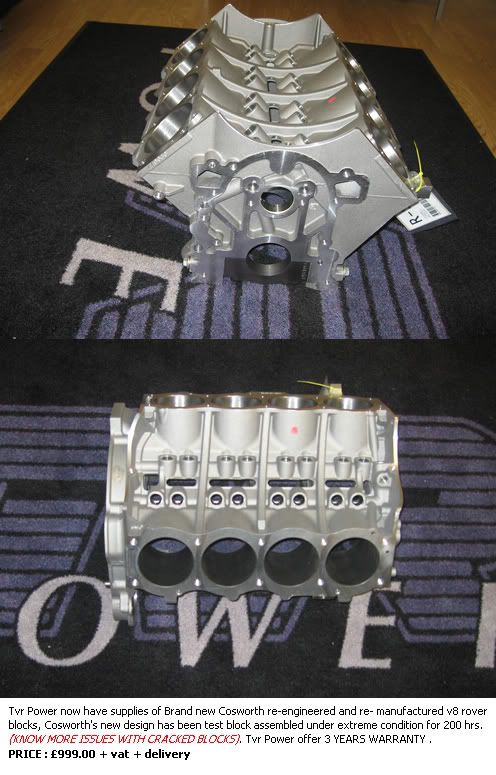
Ozzie blocks P76/Terrier are prone to flex and crack in the valley area when the torque output goes up because they are simply a raised blocks version of early Rover block with no extra bracing.
Do you think it can be an good idea to weld extra bracing to beef up the block ?
I have heard of this problem before, is the problem more common when non standard type inlet manifolds are being used, ie manifolds that do not link the two banks of cylinders such as with throttle bodies or downdraft carbs, or possibly crossover systems.
If you are able, or have access to someone who can do the welding accurately without fear of distortion, or imposing additional stress to the block, I do not see why it can't be done.
As an extra point, I was always a bit concerned about the somewhat rough and ragged finishing of the drain back areas between the lifter bores, which is much smoother and well finished in the later Coscast and Mahle blocks.
Some work in this area would reduce the risk of cracking as it has to be the weakest point in the blocks.
If you haven't got a pictiure I can e-mail you one.
Hi
I am unsure that you will be able to weld the block without introducing alot of stress and distortion, you will need to pre heat the block evenly to as hot as you can prior to welding, weld it a little bit at a time then get it to cool slowly, a big job! I cant help thinking a bottom end brace in 1" ally would probably stabalise the bottom of the block pretty well then add another stifening plate below any inlet manifold as implied by Kevin (I would recess it into the top of the block and tap into the deck part of the top of the block with lots of bolts, then bolt into the plate from the end webs)
I may be wrong, but welding in webs as you have drawn is a different thing all together to welding up a crack in a block.
Mike
Yes and no,
Dont see why it cant be done, the way you have shown in you drgs will not work if you bring the weld up that high as it will interfere with the valley gasket,
You will however introduce a huge amount of distortion to the block, no matter how carefully it is welded, the biggest problem would be in the lifter/cam area as the cam bearings would be pulled all over the place, the whole block will certainly need to be machined back to basics, so that would be bearing cap seats, line bored, possibly block skirt, cam line bored, new cam bearings found to fit those dimensions, depending on how much the cam bore and crank bore have moved rebore all 16 lifter bores and reline with Phosporbronze inserts, deck the block and rebore,
Now if this was a really rare block and needed to be saved, I would say do it, but for the sake of a P76 block it would not be financially viable once all the machining is done
I could see a ally spacer valley plate made to fit the heads and ported to suit this would enable you to use a rover type manifold rather than a bodged P76 manifold. it woild take a bit of machining and somebody with a good set of heavy duty roller to get the shape of the valley, or make the plate in MDF and get one cast
THE SMOKING GNU
12.604 with an old boiler of a RV8 and no gas
WHY are there so many IANS on this site???????
If you had a p76 crank and set of rods to use, could you not get a 3.9 or 4.6 block (I don't know what size mains the P76 is) that is already stiff as cast, pull the liners out, machine out the deck around the cylinders and head stud holes, make up a nice chunky (1" or whatever brings it up the same deck as the P76) deck plate and drop through a set of top hat liners to whatever bore you want (within reason). Or is there a difference in the skirt area of a P76 block.
Mike
thats the sort of thing I was talking about.
Imagine the ally sheet a bit thicker, first made in MDF and then cast in ally, about 10mm thick, would tie the heads together bolt it to the rails front and back, and bolt it to the heads with c/sunk bolts then you can use the standard type RV8 manifold
THE SMOKING GNU
12.604 with an old boiler of a RV8 and no gas
WHY are there so many IANS on this site???????
Ok ok so welding seems not an good idea... so I thought of may be another solution.... (hope you will not fall of your chair ).
Instead of welding who risks to generate to much stress in the block.... why not use some epoxy glue...to fix bracings Like epoxy used for spacefram, aeronautic, etc....
Most of the epoxies will not work as they are temperature sensitive. The aeronautical stuff like Hysol, Magnabond and Metalset will lose their integrity as they get hot and become almost useless. I don't know the actual figures but will ask our structures guy and see what he says.
I would not use them in any engine of mine for that application, for what it's worth. Stick with the tested method and fit a manifold that ties the heads together and use a brace on the bottom end.
There's no reason why your original idea couldn't help if you modified the shape of the bracing a bit. If you keep the braces below the valley gasket (ie cut a curve in the top of them) then they will strengthen the block. However, I'm not convinced that they would strenghthen the block enough to prevent the damage you show. as well as the locations that your drawing shows, I would also brace between the tappets where the damage is occurring. A fairly simple knowledge of casting stresses (please correct me if I'm wrong) would suggest that the damage is occurring at the point that already has very high stresses due to shrinkage during cooling. Annealing this area may help, but I would suggest welding in a brace over the stress area such that the brace is in compression (ie the block is at high temperature during welding). However, please be aware that while I have some knowledge of fracture mechanics, my knowledge of casting shrinkage is limited. It may be worth speaking to a specialist in this field before modifying your block
Greg - reinforcements as shown in your graphics will strengthen the valley area as long as the braces are made of the correct material - the coefficient of thermal expansion must be less than that of the block to make those braces work, otherwise the stresses will make things worse. As long as suitable bolts are used (high shear stress) this makes a very good solution
Most epoxies start seriously degrading at about 90C - rather close to the operating temperature of a V8 for comfort. Many of those that claim a higher temperature will not survive at that temperature long term.
Bryan, you seem to know your stuff about stresses and stuff etc....
I think what Dimitri is saying that because the p76 block has higher cylinder banks than the rover there is greater leverage applied from any stresses applied to the block at the deck, from say expansion/contraction, mechanical stresses from the actual working of the engine...etc. This is what causes a specific problem with p76 blocks
I take your point about the differences in expansion between the engine block and any bits welded on it.
Apart from the higher banks there is no difference between the normal rover blocks and the p76 in terms of the tappet area which is generally not a problem with these engines as far as I know, So I think what Dimitri wants to do is reinforce the actual cylinder banks which is what causes the initial problem with the p76 blocks rather than the small structures in the tappet area.










 ).
). Like epoxy used for spacefram, aeronautic, etc....