Thanks all! Here's some answers.
This version was designed with production & servicing very much in mind, learning lots (usually about what not to do) from the previous version.
There's a couple of things to do that would make production even easier, but however you look at it, it's not going to be the cheapest thing to build. Having said that, we wouldn't rule out some form of build to order production at this stage.
The intake temperature measured in the mark 1 version (with rather poorer intake routing) showed no more than +5 degrees over ambient when moving at 40+ mph. In traffic, it quickly heatsoaked, but this is a problem for any intake. I have some heat shields for the exhaust ready to go on the car. The sit a few mm above the exhaust and duct a little air from the radiator exit over the manifolds and down the transmission tunnel. I hope this further reduces underbonnet temperatures.
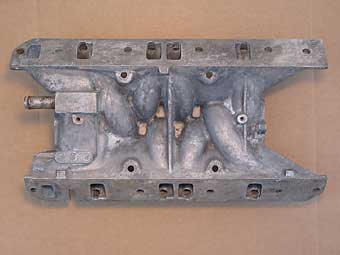
There is no need to put a complicated crossover in the design to make the firing sequence use alternate plenums. The Rover manifold design covers this aspect very nicely. Yes it does give a nice flat & wide torque curve

(greater than 300 ftlbs from 1600 to 6000 RPM on the version 1)
Interesting comment on the manifold Wotland. I am not sure what manifold it is, other than it not being Thor. It's been extensively altered both by TVR and me, so it ought to be better than standard. I have individual cylinder fuel trims and the means to set them up, so if worst comes to worst I can at least mask the problem.