
Hello Craig,
Thanks for the update!
The black soot sounds a bit rich, but as you indicate the cooling problem is preventing a proper evaluation.
Ron.
Which SU Needles?
Moderator: phpBB2 - Administrators

Hi,RoverP6B wrote:Hello Craig,
Have you had time to sort out the cooling problems?
If so, how have the needles shaped up?
Ron.
Sorry it has taken so long to reply but I've been in holiday abroad.
Spent some time yesterday blocking off the gaps between radiator and the nosecone to direct all air through the core but this doesn't seem to have resolved my cooling problems. I'm going to try draining the coolant and doing a thorough flush of the engine and radiator to see if that will help as I can't think of anything else which might help. So far I've done the following:
Changed the carb needles to ensure the engine is not lean.
Changed dizzy timing to ensure it is not too retarded.
Changed expansion tank from expansion only to full flow self bleed type.
Changed water pump pulley from 6.5" to 5.75" to speed up flow.
Changed thermostat from 82 to 74 degree.
Changed fan switch to lower temperature cut in.
Checked temperatures of top and bottom hoses using infra-red thermometer.
But still the engine temperature slowly climbs while out on the road from cold to 110C over the course of 10 minutes or so. This shouldn't happen with a 74C thermostat surely.
Will stick at it and report back.
Cheers,
Craig.


 after only 10 minutes...yes definitely..what size is the radiator?
 Hi Chris and Ron,
The radiator is an aluminium cored, plastic end-tank affair from a variety of VW vehicles including a few Polo, Golf and Passat models. You can see the very rad in my build diary here:
http://www.meerkats.uk.com/meerkats/Loc ... Year!.html
It is about 460mm x 330mm x 32mm and has 17 tubes running horizontally and very densely packed fins running vertically (about 17 fins per inch). The inlet and outlet pipes are each 32mm o/d and are on the same side of the radiator. My understanding is that the water flows across the top half of the core down the other end tank and back across the lower half of the core.
The radiator is mounted within the nosecone (as high as possible) but the top hose still runs downward from thermostat to radiator. This is not ideal I know but difficult to avoid. My top hose also has to go up and over the dizzy.
I've used a Polo electric fan with the associated cowling and as I mentioned I have now blocked off the area around the radiator to force all air through the rad core after it comes in the nosecone.
When I said the car comes up to 110 in 10 minutes, I should state my assumption that the mark on the Rover SD1 temp gauge after 90C is 110C since the next one after that is 130C. However, the mark is actually closer to the 90C mark than the 130C mark and may indicate 100C or in fact any arbitrary temperature. It may just signify the "hot" mark.
Also, it may have been 15 minutes before it reached that mark, I didn't time it specifically. The run consisted of driving between three roundabouts nearby which are separated by about 0.5 miles each. I was just accelerating briskly, not fiercely, up to 50 or 60MPH or so and then cruising along to the next roundabout and doing the same again. I did a few circuits before it was clear my temps were not going to stop at the 80C mark or thereabouts which is what I was hoping for.
When I got home I measured a few temps using my infrared thermometer. The area of inlet manifold around the coolant sensor was reading 100C with the top hose in the mid 90s. The bottom hose (with fan running) was mid 70s showing a 20 degree drop through the radiator - I don't know if this is sufficient or if there should be a greater drop. I also measured he cylinder head just above the engine number between cylinders 3 and 5 and it was 150C. The block was a bit cooler just on the engine number at mid 130s. The exhaust manifolds (cast) were around 320C!!
So, do you think I need to look into a bigger radiator? Alternatively do you think maybe my block needs to be caustic flushed? It did sit without antifreeze in it for a few months (inadvertently) and when I flushed it through there was quite a bit of rusty water expelled before the water ran clear. I did this flushing with the engine running and revved it up a few times to churn up the sediment until doing so yielded no more rusty water. Maybe I've blocked some radiator cores? I'm using the pink Halfords anti-freeze now which is 50% concentration.
My next plan is to do a thorough flush of the cooling system, especially the radiator and to look into some sort of caustic flushing compound which can be used on alloy engines. Any suggestions are most welcome.
Thanks,
Craig.
ps. Sorry for the long post...
The radiator is an aluminium cored, plastic end-tank affair from a variety of VW vehicles including a few Polo, Golf and Passat models. You can see the very rad in my build diary here:
http://www.meerkats.uk.com/meerkats/Loc ... Year!.html
It is about 460mm x 330mm x 32mm and has 17 tubes running horizontally and very densely packed fins running vertically (about 17 fins per inch). The inlet and outlet pipes are each 32mm o/d and are on the same side of the radiator. My understanding is that the water flows across the top half of the core down the other end tank and back across the lower half of the core.
The radiator is mounted within the nosecone (as high as possible) but the top hose still runs downward from thermostat to radiator. This is not ideal I know but difficult to avoid. My top hose also has to go up and over the dizzy.
I've used a Polo electric fan with the associated cowling and as I mentioned I have now blocked off the area around the radiator to force all air through the rad core after it comes in the nosecone.
When I said the car comes up to 110 in 10 minutes, I should state my assumption that the mark on the Rover SD1 temp gauge after 90C is 110C since the next one after that is 130C. However, the mark is actually closer to the 90C mark than the 130C mark and may indicate 100C or in fact any arbitrary temperature. It may just signify the "hot" mark.
Also, it may have been 15 minutes before it reached that mark, I didn't time it specifically. The run consisted of driving between three roundabouts nearby which are separated by about 0.5 miles each. I was just accelerating briskly, not fiercely, up to 50 or 60MPH or so and then cruising along to the next roundabout and doing the same again. I did a few circuits before it was clear my temps were not going to stop at the 80C mark or thereabouts which is what I was hoping for.
When I got home I measured a few temps using my infrared thermometer. The area of inlet manifold around the coolant sensor was reading 100C with the top hose in the mid 90s. The bottom hose (with fan running) was mid 70s showing a 20 degree drop through the radiator - I don't know if this is sufficient or if there should be a greater drop. I also measured he cylinder head just above the engine number between cylinders 3 and 5 and it was 150C. The block was a bit cooler just on the engine number at mid 130s. The exhaust manifolds (cast) were around 320C!!
So, do you think I need to look into a bigger radiator? Alternatively do you think maybe my block needs to be caustic flushed? It did sit without antifreeze in it for a few months (inadvertently) and when I flushed it through there was quite a bit of rusty water expelled before the water ran clear. I did this flushing with the engine running and revved it up a few times to churn up the sediment until doing so yielded no more rusty water. Maybe I've blocked some radiator cores? I'm using the pink Halfords anti-freeze now which is 50% concentration.
My next plan is to do a thorough flush of the cooling system, especially the radiator and to look into some sort of caustic flushing compound which can be used on alloy engines. Any suggestions are most welcome.
Thanks,
Craig.
ps. Sorry for the long post...
My gut feel is that rad is way too small. Here's a pic of the rad on my sherpa:
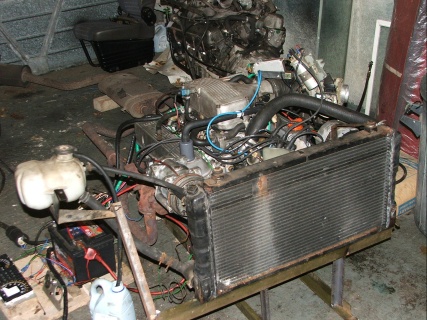
which is sized about right for that engine.
If the exit water is about 70deg, that doesn't allow the engine to add many degrees to it before the thermostat is needing to open.
Cooling the RV8 is a recurring theme, because it really does need a decent rad.
Of course, the air needs to be able to get out from behind the rad too - as I have discovered in my Landie when I have the engine under-tray fitted which pretty well seals the engine compartment, then it gets a bit warm!
Chris.
which is sized about right for that engine.
If the exit water is about 70deg, that doesn't allow the engine to add many degrees to it before the thermostat is needing to open.
Cooling the RV8 is a recurring theme, because it really does need a decent rad.
Of course, the air needs to be able to get out from behind the rad too - as I have discovered in my Landie when I have the engine under-tray fitted which pretty well seals the engine compartment, then it gets a bit warm!
Chris.
--
Series IIA 4.6 V8
R/R P38 4.6 V8
R/R L405 4.4 SDV8
Series IIA 4.6 V8
R/R P38 4.6 V8
R/R L405 4.4 SDV8
Hi,
THis has been a slight concern of mine since I originally selected the Polo radiator to be honest. However, I was assured by others on the locostbuilders.co.uk forum that the Polo radiator had been used on engines which produced considerably more BHP than my own 155BHP+ engine. I don't know enough about cooling theory to know whether BHP is the only concern when sizing a radiator but I suspect that it is not. I would expect that water volume, water pump capacity and the construction of the engine waterways within the block will all play a part. I also expect that engine efficiency will be important and in this regard the Rover V8 will be well behind a modern multivalve engine. Perhaps a better measure of cooling requirements would be fuel consumption since it is the burning of the fuel which creates the heat. In fact, the correct measure of cooling needs should be proportional to the difference between chemical potential (ie fuel energy) consumed and mechnical energy released through the crankshaft.
Okay, so lets say I want to go get a more suitable radiator - what am I looking for? I have height and width constraints which mean I can only accommodate a radiator perhaps 50mm wider and 25mm taller than the one I currently have fitted although it could be quite a bit deeper. It would be more convenient for hose routing if I got a radiator with diagonally opposite inlet outlet arrangement and I think this is supposed to be more efficient as well. I don't know a lot about radiator design so would appreciate any advice on how many cores to look for, fin density, core material, end tank material etc.
Also, I note from the Westfield website that the Westfield SEight uses a ducted nosecone which prevents hot air which has passed through the radiator from entering the engine bay. Instead, the air passes out through a slot in the top of the nosecone. This has to be worth doing eh? Especially since my nosecone is still unpainted and has already been modified to clear the dizzy and alternator. I don't mind cutting into it a bit more.
Finally, do you think heat wrapping the exhaust manifolds would make a big difference?
Maybe I should ask the above questions in the cooling forum...
Thanks,Craig.
THis has been a slight concern of mine since I originally selected the Polo radiator to be honest. However, I was assured by others on the locostbuilders.co.uk forum that the Polo radiator had been used on engines which produced considerably more BHP than my own 155BHP+ engine. I don't know enough about cooling theory to know whether BHP is the only concern when sizing a radiator but I suspect that it is not. I would expect that water volume, water pump capacity and the construction of the engine waterways within the block will all play a part. I also expect that engine efficiency will be important and in this regard the Rover V8 will be well behind a modern multivalve engine. Perhaps a better measure of cooling requirements would be fuel consumption since it is the burning of the fuel which creates the heat. In fact, the correct measure of cooling needs should be proportional to the difference between chemical potential (ie fuel energy) consumed and mechnical energy released through the crankshaft.
Okay, so lets say I want to go get a more suitable radiator - what am I looking for? I have height and width constraints which mean I can only accommodate a radiator perhaps 50mm wider and 25mm taller than the one I currently have fitted although it could be quite a bit deeper. It would be more convenient for hose routing if I got a radiator with diagonally opposite inlet outlet arrangement and I think this is supposed to be more efficient as well. I don't know a lot about radiator design so would appreciate any advice on how many cores to look for, fin density, core material, end tank material etc.
Also, I note from the Westfield website that the Westfield SEight uses a ducted nosecone which prevents hot air which has passed through the radiator from entering the engine bay. Instead, the air passes out through a slot in the top of the nosecone. This has to be worth doing eh? Especially since my nosecone is still unpainted and has already been modified to clear the dizzy and alternator. I don't mind cutting into it a bit more.
Finally, do you think heat wrapping the exhaust manifolds would make a big difference?
Maybe I should ask the above questions in the cooling forum...
Thanks,Craig.
I would tend to agree that it's to do with fuel consumption rather than BHP. An RV8 generates a huge amount of heat compared to a small 4-pot, due to friction alone! That's before it burns fuel in it's inefficient combustion chambers.
The issue with a thicker radiator is that when the air passing through it has reached the same temp as the water, adding thickness will not improve cooling.
Exactly where that optimum thickness point is, I don't know.
I'd also add that an engine driven fan is vastly superior to an electric one.
Maybe you can get some rads from the scrapyard and try them with the engine idling just to see if the temp can be kept down.
Chris.
The issue with a thicker radiator is that when the air passing through it has reached the same temp as the water, adding thickness will not improve cooling.
Exactly where that optimum thickness point is, I don't know.
I'd also add that an engine driven fan is vastly superior to an electric one.
Maybe you can get some rads from the scrapyard and try them with the engine idling just to see if the temp can be kept down.
Chris.
--
Series IIA 4.6 V8
R/R P38 4.6 V8
R/R L405 4.4 SDV8
Series IIA 4.6 V8
R/R P38 4.6 V8
R/R L405 4.4 SDV8
Hello Craig,
The standard radiator core fitted into the Rover P6B measures 580mm wide by 460mm deep. This does not include the end tanks. It is a dual core.
The core that I am using is a triple core with the same dimensions of width and depth as above. It does make a marked reduction in running temperature.
I have read conflicting information on the best material for radiators, some say aluminium, others copper and brass. I have never used an aluminium radiator, and I don't have overheating problems with copper and brass.
If you are running tubular manifolds, the best solution for reducing radiated heat is ceramic coating. This can also be applied to cast iron manifolds. In both cases it looks great and won't reduce the life of the product.
Ron.
The standard radiator core fitted into the Rover P6B measures 580mm wide by 460mm deep. This does not include the end tanks. It is a dual core.
The core that I am using is a triple core with the same dimensions of width and depth as above. It does make a marked reduction in running temperature.
I have read conflicting information on the best material for radiators, some say aluminium, others copper and brass. I have never used an aluminium radiator, and I don't have overheating problems with copper and brass.
If you are running tubular manifolds, the best solution for reducing radiated heat is ceramic coating. This can also be applied to cast iron manifolds. In both cases it looks great and won't reduce the life of the product.
Ron.
4.6 Rover 3500 P6B
Guys,
Take a look at this beauty!
http://www.westfieldbuild.com/images/hi ... G_2749.JPG
Note that the image is very high res which is why I didn't embed it.
Here is a lower res image embedded:

This has 34 cross tubes compared to my 17 and they are each much finer. My cross tubes are quite chunky. I also note that the fins are bonded in a more conventional manner like a continuous band of metal in a sine wave pattern. My radiator almost looks like the fins are separate.
I don't know how big the radiator is but I'm pretty sure it is bigger than mine! However, this is from a Westfield SEight V8 so the nosecone size is probably similar to mine.
Not cheap I suspect...
I turns out this radiator is the same size as the Polo radiator I am using but has a high efficiency core. According to this website anyway:
http://www.radtec.co.uk/index.php?p0=de ... o=RUNI%201
Craig.
Take a look at this beauty!
http://www.westfieldbuild.com/images/hi ... G_2749.JPG
Note that the image is very high res which is why I didn't embed it.
Here is a lower res image embedded:
This has 34 cross tubes compared to my 17 and they are each much finer. My cross tubes are quite chunky. I also note that the fins are bonded in a more conventional manner like a continuous band of metal in a sine wave pattern. My radiator almost looks like the fins are separate.
I don't know how big the radiator is but I'm pretty sure it is bigger than mine! However, this is from a Westfield SEight V8 so the nosecone size is probably similar to mine.
Not cheap I suspect...
I turns out this radiator is the same size as the Polo radiator I am using but has a high efficiency core. According to this website anyway:
http://www.radtec.co.uk/index.php?p0=de ... o=RUNI%201
Craig.
Hi guys,
I decided to continue my search for cooling system nirvana over on the cooling system forum section...
Thread is here:
http://www.v8forum.co.uk/forum/viewtopic.php?t=6033
Thanks,
Craig.
I decided to continue my search for cooling system nirvana over on the cooling system forum section...
Thread is here:
http://www.v8forum.co.uk/forum/viewtopic.php?t=6033
Thanks,
Craig.