Page 1 of 1
Anyone had a cam go flat?
Posted: Tue Sep 02, 2008 9:54 pm
by bugster
Hi. My name is Chris Burns and I'm an aircooled VW engine builder and have been doing this for the past 18 years or so. Recently I've lost a couple of cams and so have a few friends who do the same sort of thing. Nothing has really changed in the way we build them and the parts have remained the same. We even had a chance to test a new cam and lifter set to a set made about 10 years ago and they both came out with the same Rockwell C grading. I've been adding a substance called ZDDP to the oil in the engines I now build and they seem ok for now, but haven't really done big miles as yet so it's hard to tell. I've read that the percentages of ZDDP have fallen in oils over the past few years as they harm cats and as most cars nowadays have OBD and OHCs ZDDP is both harmful and not necessary.
I was wondering if any of you gentlemen have had any similar problems and what you do to overcome these problems. If anyone wants a couple of bottles of this ZDDP stuff, I can supply some. Not too many as I've only got about 30 bottles left. I bottle treats about 5 litres.
Posted: Tue Sep 02, 2008 10:22 pm
by kev_the_mole
My engine builder has also seen this problem with current oils and is now rightly paranoid about cam break-in procedures and using the right oils for flat tappet cams.
Posted: Fri Sep 05, 2008 2:36 pm
by CastleMGBV8
Chris,
This subject came up a while ago on another board I frequent and there were pages of tech stuff explaining why it happens.
In a nutshell it was using modern synthetic oils in older design engines, they just aren't suitable.
It would be better to use a good 20/50 such as Valvoline or Castrol or similar or one of the modern deisel engine oils that have more of the required additives.
I was talking to my engine builder and he mentioned a guy running a Pinto race engine that kept knackering the cam, he was running a race synthetic oil but has now changed to the old fashioned stuff and has had no further problems.
Kevin.
Posted: Fri Sep 05, 2008 6:43 pm
by kiwicar
The stuff I have read in carcraft and hot rod says it is the as you state it is the reduced level of the zinc addatives, they are said to be critical in the first running in phase of a flat tappet cam. the way around it is said to be to run older style oils with the right addative packs (if you can get them) or to do your first run in stage with a deisel engine oil. The run in phase however is also meant to be more critical hence the frequent debate on here about how best to do it.
If you can convert to a roller cam set up then it is no longer a problem (though the issue of molibdimum addatives is then an issue)
Is this for your replica porsche 908 engine??


Mike
Posted: Fri Sep 05, 2008 9:13 pm
by stevieturbo
As above...many indications seem to suggest its oil related on flat tappet cams.
It might be worth contacting the likes of Millers Oils and asking them about it. They make some pretty good oils....so would know what to use.
Posted: Fri Sep 05, 2008 9:58 pm
by bugster
The general consensus among Vw guys (as one of us is a petro-chem engineer and gave us a big list as to why) is not to use diesel engine oil in performance petrol engines because, among others, though it does have higher zddp levels, it also has much else besides which is not beneficial to higher revving petrol engines.
As to synthetic engine oils, we don't generally run tham as they are thin and these old Beetle engines have a tendency to leak anyway. Also the clearances are generally larger than on newer machinery.
Roller cam and followers would be nice but there is no room for all that in a shitty little Beetle engine case. One change on high buck engines is ceramic lifters and these have a record of not having had a single failure due to wear worldwide as yet. Some have shattered when not enough valve spring pressure has been used.
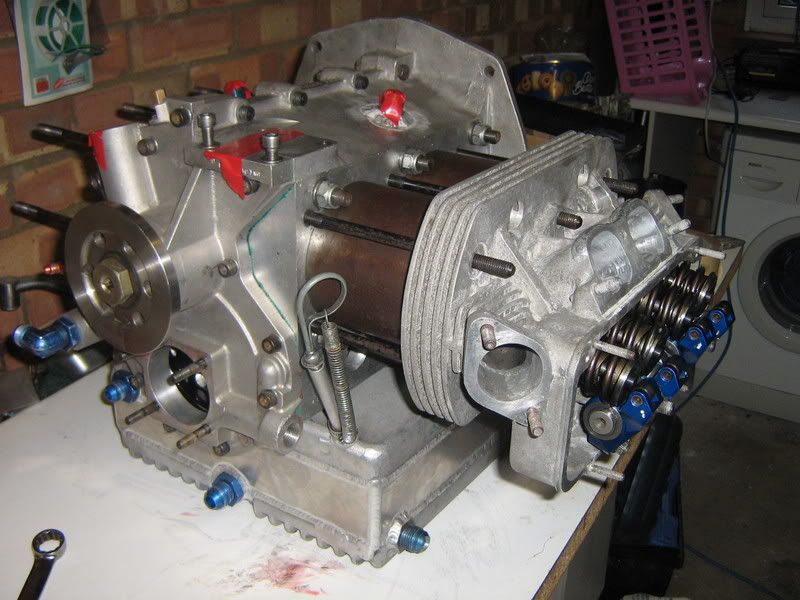
This is my car

and this is the engine during a fresheneing up
Posted: Fri Sep 05, 2008 11:48 pm
by RoverP6B
When my 4.6 was built last year, for the first 750km the oil used was Penrite 20W50 Running In Oil. From then on I have been using Penrite HPR30 20W60, which I have found to be excellent.
Penrite put their name to all Land Rover lubricant requirements...and that is certainly the case in Australia.
Ron.
Posted: Sat Sep 06, 2008 8:29 am
by topcatcustom
So thats what a not quite standard bug engine looks like!!!

Posted: Sat Sep 06, 2008 10:19 am
by HairbearTE
The dipstick could be a VW part, the rest sure aint!
Posted: Sat Sep 06, 2008 10:31 am
by kiwicar
That is very pretty, but I still think you need 4 more cylinders, now that would really turn heads!
Mike
Posted: Sun Sep 07, 2008 10:32 am
by bugster
Yes, it's true, the dipstick is the only VW part. Someone here knows their VW engines.
The same is true for the car as the only standard vw part is the door catch.
Posted: Sun Sep 14, 2008 6:44 am
by minorv8
That is very pretty, but I still think you need 4 more cylinders, now that would really turn heads!
The really sad part is that VWs tend to be really fast on 1/4 mile with only 4 cylinders compared to other engines. What I have seen, the power is not a problem, it is the transaxle. Judging by the looks of the engine, tranny is also something aftermarket stuff...
One other thing, even trick stuff is quite affordable compared to Rover bits.